
25 July 2026
Windows you cannot reach — ladders, lifts and fall protection
Why a cleaning company sometimes declines the upstairs windows, and what to mention in advance so the visit is not cut short.
Why the question comes up
Window cleaning at ground level is a simple service. The windows one floor up, the patio glazing or the roof window are something else: what can be done there is decided by the work-environment rules that apply to the company's employees, not by what you or they consider reasonable.
That is why a serious company can decline a job an individual would simply climb up and do. The difference is not caution — it is that an employer carries a responsibility you do not carry in your own garden.
What the rules actually say about ladders
The use of ladders and trestles is regulated by the Swedish Work Environment Authority's provisions on the safe use of work equipment and personal protective equipment, AFS 2023:11, chapter 7. On its page about ladders and trestles the Authority states, among other things, that:
- a leaning ladder is most stable at an angle of about 75 degrees;
- safety improves if the ladder is anchored at the top with a strap, rope or similar;
- a ladder is unsuitable if it has to stand on slippery or uneven ground, if you need to reach very high or across a large area, or if the work requires both hands.
That last point is usually the decisive one for window cleaning: a squeegee in one hand and a washer in the other is precisely what makes the ladder the wrong equipment. (Source: Arbetsmiljöverket, Stegar och arbetsbockar.)
The Authority also puts it plainly: avoid working from a ladder where possible. A ladder is intended for short, occasional tasks where there is no better alternative.
Fall protection
For construction and civil-engineering work the Authority states explicitly that measures against fall risks are required where the work involves a risk of falling two metres or more, and that collective fall protection must be the first choice — personal fall-arrest equipment is "always a last resort". Window cleaning is not construction work, but the risk assessment is the same, and according to the Authority it must be carried out regardless of the fall height. (Source: Arbetsmiljöverket, Arbete med fallrisk.)
In practice the alternatives to a ladder are scaffolding, a cherry picker, or a telescopic pole used from the ground — and choosing between them is the company's assessment to make, not the customer's.
What this means for your booking
- Say so in the enquiry. "Eight windows, four of them upstairs, no balcony" gets you a realistic price. Discovered on site, it makes the visit either more expensive or half-finished.
- Expect height to cost more. It is equipment and often two people, not a surcharge for inconvenience.
- Check access if a lift may be needed: a cherry picker has to get there and stand firm, which depends on your drive and the ground.
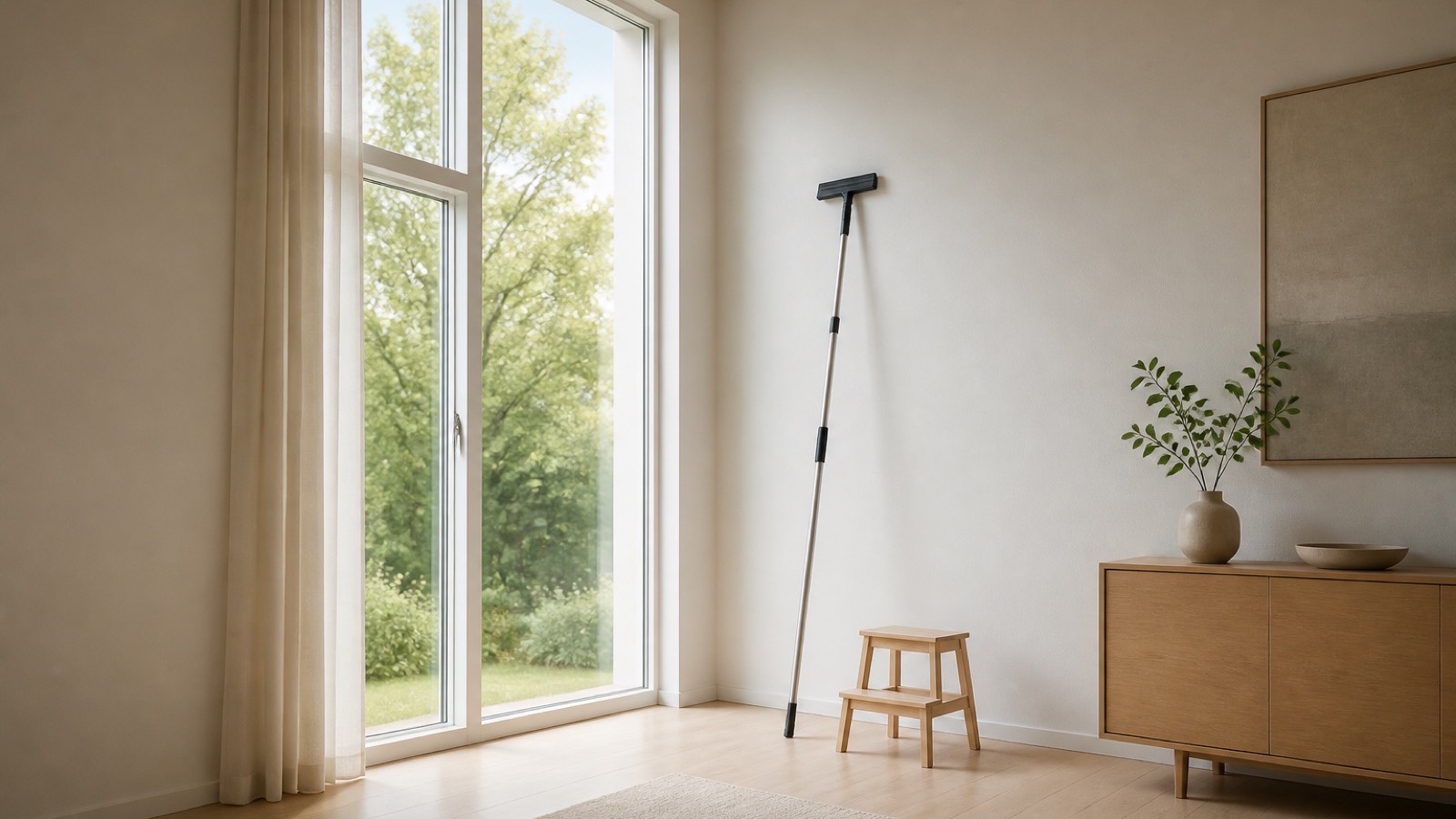
- A telescopic pole with deionised water reaches many windows from the ground without anyone climbing — ask whether the company works that way, rather than asking whether their ladder is long enough.
- Consider what you do yourself. The rules above bind employers, not you privately. The fall height is the same either way.
Further reading
What a job covers otherwise — pane, frame, glazing bars, inside and outside — is set out in what window cleaning includes. To compare companies in your municipality, see window cleaning municipality by municipality.